
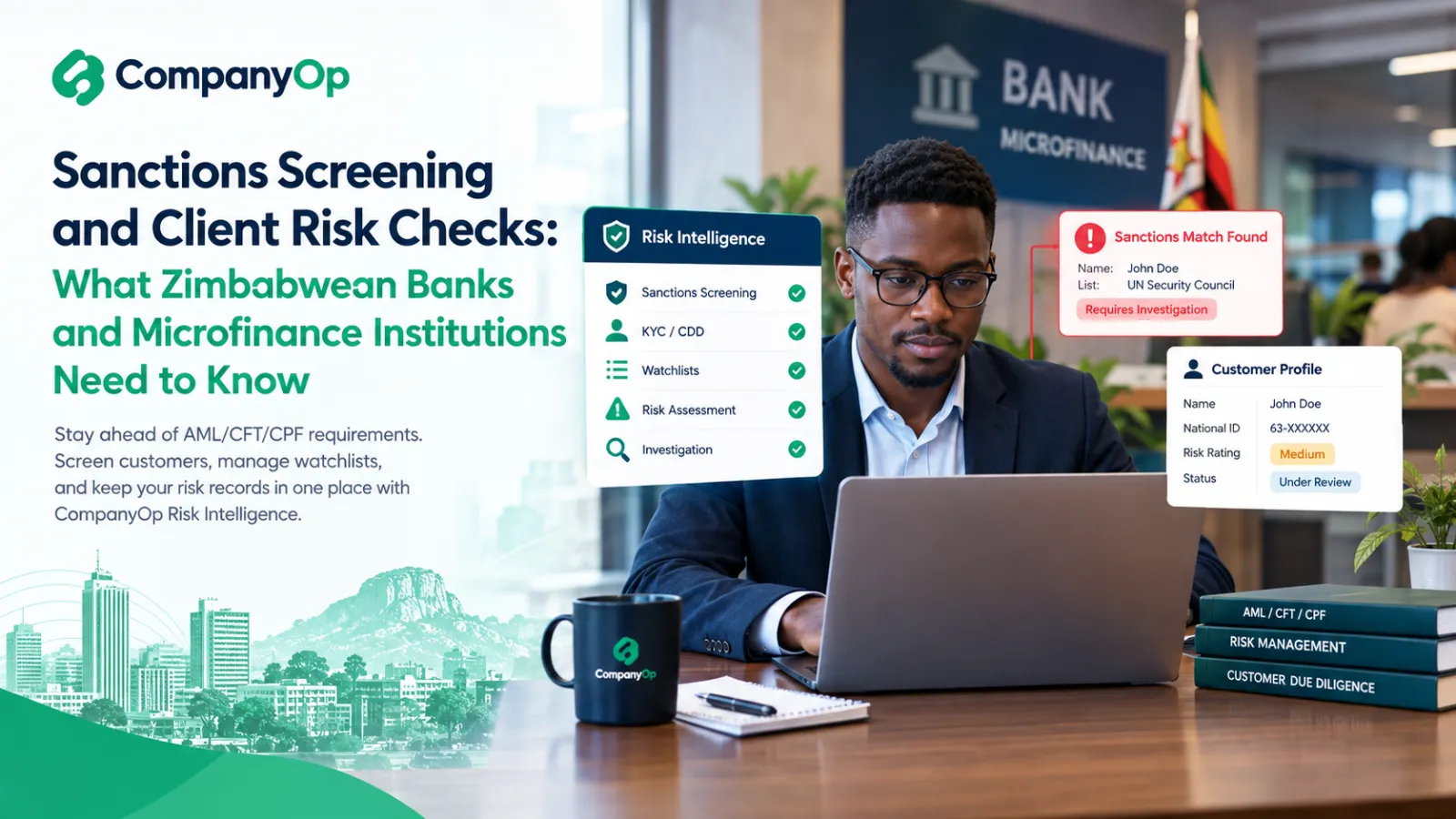
For a bank or microfinance institution, knowing your customer is no longer just about collecting an ID, proof of address and a few application forms.
Financial institutions are expected to understand who they are dealing with, assess the risks associated with customers and business relationships, and take appropriate action when those risks become apparent.
In Zimbabwe, this is part of a wider Anti-Money Laundering, Counter-Terrorist Financing and Counter-Proliferation Financing framework.
And as financial institutions onboard more customers, borrowers and businesses, doing these checks manually becomes increasingly difficult.
That is where technology can help.
Zimbabwe's financial sector is operating under stronger AML/CFT/CPF expectations
Zimbabwe's AML/CFT framework is built around several pieces of legislation, including the Money Laundering and Proceeds of Crime Act [Chapter 9:24], the Bank Use Promotion Act [Chapter 24:24], the Suppression of Foreign and International Terrorism Act [Chapter 11:21], and regulations implementing United Nations Security Council sanctions. The Financial Intelligence Unit identifies these as core parts of Zimbabwe's AML/CFT legal framework.
The Money Laundering and Proceeds of Crime Act places obligations on financial institutions around customer identification, risk management, enhanced due diligence and ongoing monitoring.
For example, section 20 of the Money Laundering and Proceeds of Crime Act provides that financial institutions and designated non-financial businesses and professions must have appropriate risk-management systems to identify high-risk customers and apply enhanced identification, verification and ongoing due diligence to them.
The Act also requires institutions to determine whether customers or beneficial owners are politically exposed persons and, where applicable, take measures including enhanced monitoring and identifying the source of wealth and funds.
In other words, customer risk is not something that should be considered only when an account is opened or a loan is approved.
It needs to be managed throughout the relationship.
Sanctions screening is becoming a practical operational requirement
The Reserve Bank of Zimbabwe's AML/CFT/CPF Guideline No. 01-2025/BSSFS, which became effective on 1 June 2025, provides more specific guidance around targeted financial sanctions.
The guideline states that reporting institutions should have sanctions-screening systems capable of identifying sanctioned individuals and entities.
It goes further.
The RBZ guideline says:
“reporting institutions should therefore have sanctions screening systems in place”
It also states that screening and monitoring systems should cover customer onboarding and payment-related information.
Where there is a potential positive match, the institution is expected to verify whether the details actually correspond to the listed person or entity. Where a positive match is confirmed, the guideline states that assets should be frozen immediately without delay.
This is important because sanctions screening is not simply a matter of typing a customer's name into Google.
A proper process needs to record what was checked, when it was checked, what result was returned and what happened after an alert was raised.
The requirements also apply to the microfinance sector
This isn't only a banking issue.
The RBZ has specifically brought banking and microfinance institutions into its AML/CFT/CPF supervisory framework.
In its 2025 Monetary Policy Statement, the RBZ stated that AML/CFT/CPF Guideline No. 1-2025/BSS&FS was issued to banking and microfinance institutions, effective 1 June 2025.
The same statement noted that licensing requirements had been enhanced to include screening of shareholders, directors and senior management of banking and microfinance institutions against the United Nations Security Council Resolutions list.
The RBZ's 2026 Monetary Policy Statement also says the Bank continues to supervise the AML/CFT/CPF obligations of both banking and microfinance institutions. It notes that risk-based customer due diligence is used at onboarding and on an ongoing basis, while most banking institutions have implemented sanctions-screening systems.
For a microfinance institution, this creates a very practical question:
How are you actually performing and recording these checks?
The problem with manual screening
Imagine a microfinance company processing hundreds or thousands of borrowers.
A loan officer receives an application.
They check the customer's ID.
They enter the customer into the loan management system.
The loan goes through approval.
But somewhere else, a compliance officer is expected to check sanctions lists, maintain spreadsheets, record potential matches and investigate alerts.
That creates a fragmented process.
The problem isn't necessarily that employees don't want to perform the checks.
The problem is that manual processes become difficult to maintain as the institution grows.
You can end up with:
Checks being performed at different stages
Different employees using different processes
Screening results stored outside the customer record
Difficulty finding historical screening evidence
Alerts being lost in email or spreadsheets
Repeated checks being performed manually
Investigations that are difficult to track
Compliance information separated from the customer's operational records
For a regulated financial institution, that is an unnecessary operational burden.
This is where Risk Intelligence from CompanyOp comes in
CompanyOp Risk Intelligence is designed to put customer screening, watchlists, KYC/CDD workflows and investigations inside the same company workspace where your operational applications already live.
Instead of treating risk screening as a completely separate process, you can connect it to the workflows that actually bring customers into your business.
For example, a microfinance institution can use it to:
Screen borrowers before disbursement
A borrower enters your lending workflow.
Before the loan is disbursed, the customer can be screened as part of the operational process.
This creates a much more structured approach to identifying potential risks before money leaves the institution.
Keep screening history
Risk Intelligence provides screening history so your team can see what checks have been performed and retain an operational record of the screening process.
That matters when your team needs to understand what happened with a particular customer.
Manage watchlists
Institutions can maintain watchlists and review alerts instead of relying entirely on disconnected spreadsheets and email conversations.
Manage KYC and CDD workflows
Customer due diligence becomes part of the same environment rather than another completely separate system.
Investigate alerts
A potential match does not automatically mean that a customer is a sanctioned person.
There needs to be a process for reviewing the alert and determining whether the details actually match.
Risk Intelligence provides workflows for managing alerts and investigations through to resolution.
Don't confuse a name match with a confirmed sanctions match
This distinction is important.
If your customer's name resembles the name of somebody on a sanctions list, that does not automatically mean the customer is the sanctioned person.
The RBZ's 2025 guideline specifically discusses verifying whether the details of a potential match actually correspond to the institution's customer before treating it as a confirmed match.
That means a useful screening system needs more than a red “MATCH” notification.
Your compliance team needs context.
They need to investigate.
They need to document the outcome.
And they need to be able to distinguish a potential match from a confirmed match.
What about politically exposed persons?
Sanctions screening is only one part of customer risk management.
The Money Laundering and Proceeds of Crime Act also specifically addresses politically exposed persons.
Section 20 requires financial institutions to determine whether a customer or beneficial owner is a politically exposed person and, where applicable, obtain senior-management approval, take reasonable measures to establish the source of wealth and funds, and apply increased ongoing monitoring.
That is why a modern customer-risk workflow should not stop at checking one sanctions list.
It should support the broader process around KYC, customer due diligence, risk identification and investigation.
The bigger advantage: connect risk to your lending operation
This is where CompanyOp becomes particularly useful for financial institutions.
CompanyOp isn't just a standalone screening application.
It is a collection of business applications designed to work together.
A microfinance institution can use its lending application alongside Risk Intelligence, accounting, bulk messaging and other applications required by the business.
The result is a connected workflow.
A customer can enter through your lending process.
Their information can be available to the relevant risk workflow.
A screening alert can be investigated.
The lending team can make the appropriate operational decision based on your institution's policies and procedures.
And the resulting information can remain associated with the customer and their business relationship.
Instead of having:
Loan Management → Spreadsheet → Email → Compliance Tool → Back to Loan Management
you can build a workflow around connected applications inside the same CompanyOp workspace.
Built for businesses that don't want to buy an enormous ERP
You don't have to purchase a massive software suite just to introduce structured risk screening.
CompanyOp lets businesses license the applications they actually need and add others as they grow.
Risk Intelligence is currently available for USD 8.99 per month per company workspace.
That gives smaller financial institutions an opportunity to introduce a structured risk and screening layer without taking on the cost and complexity of a large enterprise platform.
Compliance should not live in a spreadsheet
Zimbabwe's AML/CFT/CPF framework is becoming increasingly risk-based and technology-driven.
The RBZ's current guidance explicitly discusses sanctions-screening systems, customer onboarding, transaction monitoring and ongoing risk management.
For financial institutions, the question is therefore moving beyond:
“Do we check our customers?”
It is becoming:
“Can we consistently perform those checks, investigate alerts, retain the history and demonstrate how our process works?”
Technology cannot replace your compliance officers, policies, legal obligations or management decisions.
But the right technology can make those processes far easier to execute consistently.
Put customer risk intelligence next to your customers
If you operate a bank, microfinance institution, lender or another regulated business and customer screening is becoming a bigger part of your operational workload, CompanyOp Risk Intelligence gives you a practical place to start.
Screen customers.
Manage watchlists.
Run KYC and CDD workflows.
Track alerts.
Investigate potential matches.
Keep screening history.
And connect your risk process to the business applications your team already uses.
Start with the applications you need. Add the rest when your business is ready.
Explore CompanyOp Risk Intelligence
This article is for general informational purposes and does not constitute legal or regulatory advice. Financial institutions should obtain professional advice and ensure that their AML/CFT/CPF policies, screening procedures and technology are appropriate for their specific regulatory obligations.