
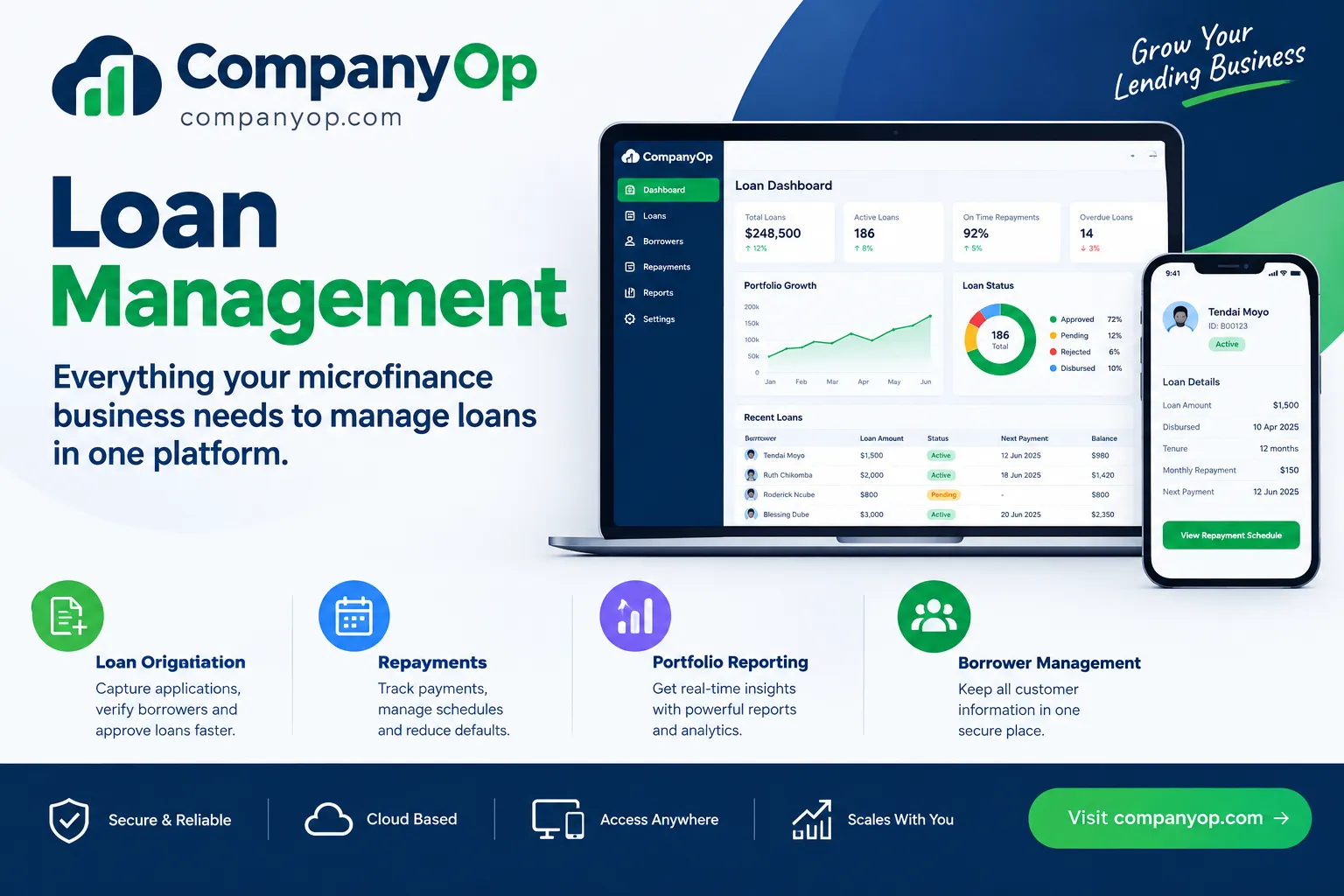
Microfinance businesses across Africa operate in a rapidly changing environment. Managing borrowers, loan products, repayments, interest, deductions, collections and reporting can become increasingly difficult when these processes are handled using spreadsheets or disconnected systems.
CompanyOp’s Loan Management System is designed to help microfinance businesses manage the complete loan lifecycle from one platform, while providing the flexibility needed to adapt to different lending models, business rules and operating environments across Africa.
Built for Microfinance Businesses
CompanyOp provides a loan management solution designed around the day-to-day needs of microfinance institutions, money lenders, credit providers and businesses that provide loans to individuals or organisations.
From customer registration and loan applications to disbursements, repayments and loan closure, the system brings the lending process into a centralised platform.
Businesses can manage their borrowers, loan accounts, repayment schedules and transactions without having to rely on multiple disconnected applications.
Flexible Loan Configuration
Every lending business operates differently. Loan products, interest rates, repayment periods, fees and approval processes can vary significantly from one organisation to another.
CompanyOp is built with flexibility in mind, allowing businesses to configure their lending operations according to their requirements.
Depending on the organisation's setup, this can include configuring different loan products, repayment periods, interest calculations, fees, charges, repayment frequencies and other lending rules.
This flexibility is particularly important in Africa, where microfinance businesses often serve different customer groups and offer different types of credit products.
Manage the Complete Loan Lifecycle
A loan management system should do more than simply record repayments.
CompanyOp can be used to manage the loan lifecycle from the initial application through approval, disbursement, repayment and eventual settlement.
A typical workflow can include:
Registering the borrower
Creating a loan application
Reviewing and approving the application
Generating the repayment schedule
Disbursing the loan
Recording repayments
Tracking outstanding balances
Managing arrears
Following up on overdue accounts
Closing the loan when the balance has been settled
Having these processes within one system gives management a clearer view of the organisation's loan portfolio.
Designed for African Lending Environments
African microfinance businesses often have requirements that are different from those of conventional commercial banks.
Businesses may operate through multiple branches, serve customers with different income structures, use various repayment methods and integrate with external systems.
CompanyOp is designed to provide the flexibility required to support these types of operations.
Whether a business is operating a small lending operation or managing a larger microfinance portfolio, the system can provide a central platform for managing lending activities.
Integration With Other Business Systems
A modern loan management system should not operate in isolation.
CompanyOp is part of a broader business platform, making it possible for the loan management application to connect with other business functions and systems.
This can help businesses reduce duplicate data entry and create better connections between departments and processes.
For example, a microfinance business may need its loan operations to work together with accounting, payroll, customer management, reporting, payment processing or other business applications.
Instead of maintaining completely separate systems, businesses can build a more connected operational environment.
SSB Deduction Instructions for Zimbabwean Civil Servants
One of the important capabilities for lenders operating in Zimbabwe is the ability to work with Salary Service Bureau (SSB) deductions.
For businesses providing loans to civil servants, repayment through payroll deductions can be an important part of the collection process.
CompanyOp's loan management system supports workflows for sending deduction instructions to SSB, allowing eligible loan repayments to be processed through the employer's payroll system.
This can significantly simplify the management of loans where repayments are collected directly from a civil servant's salary.
Instead of manually managing every deduction instruction, the lending business can manage the underlying loan information within the loan management system and use the appropriate deduction workflow.
This is particularly useful for microfinance businesses that specialise in lending to government employees in Zimbabwe.
Multiple Branches and Users
As a microfinance business grows, managing operations from a single office may no longer be sufficient.
CompanyOp can support organisations that operate with multiple users and branches, allowing businesses to structure their operations as they grow.
Management can have greater visibility across the organisation while individual users can work within the areas of the business assigned to them.
This creates a foundation for scaling the lending operation without having to completely replace the system as the organisation expands.
Better Visibility Into the Loan Portfolio
One of the biggest advantages of moving from spreadsheets and manual processes to a dedicated loan management system is visibility.
Management needs to know what is happening across the loan portfolio.
A centralised system can help answer questions such as:
How much has been disbursed?
How much is currently outstanding?
Which borrowers have overdue payments?
Which loans are approaching maturity?
How much has been collected?
Which branches are performing best?
What is the organisation's current loan portfolio?
Having this information available in one system can help management make better lending and collection decisions.
Reduce Manual Work
Manual loan administration consumes time and increases the possibility of human error.
Calculating repayment schedules, updating balances, tracking arrears and preparing deduction instructions can become difficult as the number of borrowers increases.
Automating these processes through a dedicated loan management system allows staff to spend less time performing repetitive administrative tasks and more time focusing on customers, collections and business growth.
A Platform That Can Grow With Your Business
Microfinance businesses do not remain the same size forever.
A business may start with a handful of employees and a small number of borrowers before expanding into multiple branches and serving thousands of customers.
The technology supporting the business needs to grow with it.
CompanyOp provides a broader business platform around its loan management capabilities, giving organisations the opportunity to connect lending operations with other areas of the business as their requirements evolve.
Conclusion
A successful microfinance business needs more than a system that records loans. It needs technology that can adapt to its lending model, automate repetitive processes, connect with other business systems and support the realities of the market in which it operates.
CompanyOp's Loan Management System provides microfinance businesses with a flexible platform for managing loans, borrowers, repayments, branches and lending operations.
For businesses operating in Zimbabwe, the ability to support SSB deduction instructions for civil servants adds another important capability for organisations that use payroll deductions as part of their loan repayment process.
Whether you are starting a microfinance business, replacing spreadsheets or looking for a more flexible platform for an existing lending operation, CompanyOp provides a foundation for managing your lending business digitally.
Learn more about CompanyOp and its Loan Management System at companyop.com.